 Rumor & Record
Dyatlov
Pass
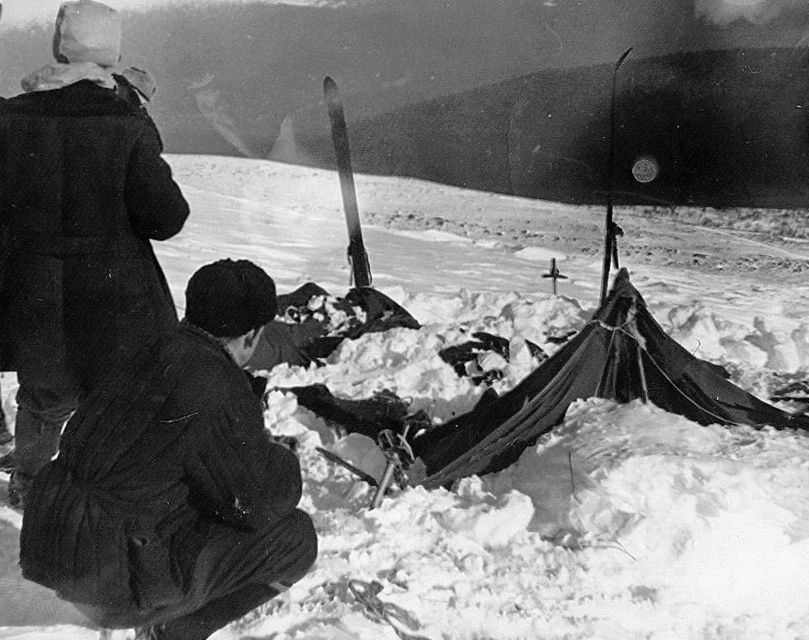
When searchers reached the tent, it was half buried in snow and cut open from the inside. Boots were still in it. Leading away downhill were nine sets of footprints, made by people in socks, a single shoe, or nothing at all. Whatever made them leave, they didn't stop to get dressed.
Follow the footprints
Stop 1 of 5This is the route the searchers pieced together, stop by stop, over three months. Tap a pin or step through in order.
Sketch based on the distances in the search records. Not a survey map; contours are illustrative.1
Ten set out
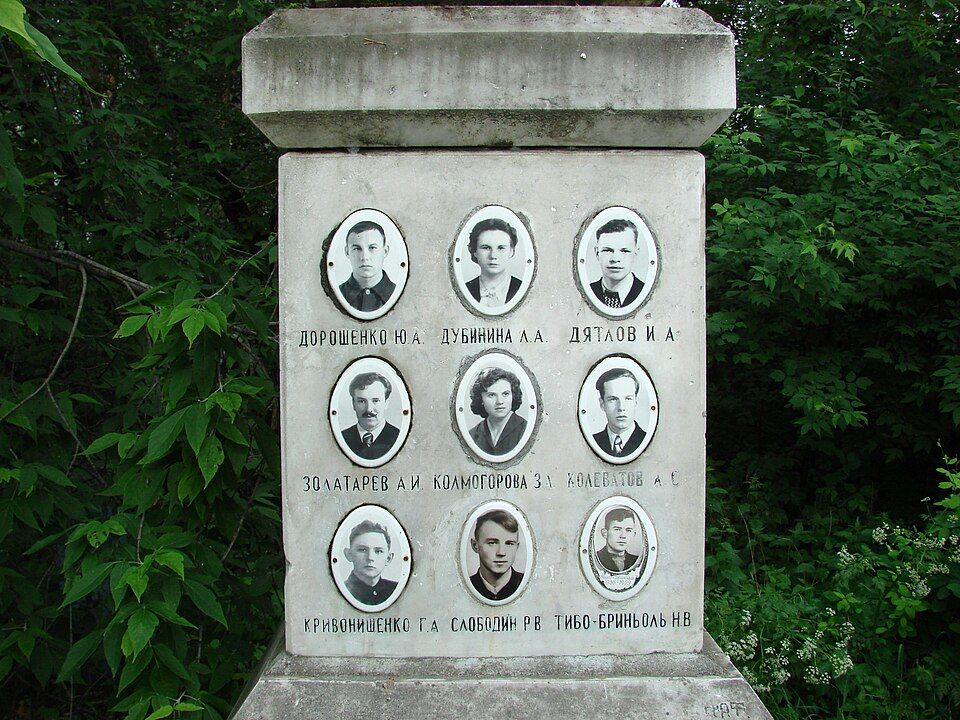
On January 23, 1959, a group of experienced hikers, most of them students or graduates of the Ural Polytechnic Institute, left Sverdlovsk for a winter trek to a mountain called Otorten. They were led by a 23-year-old radio engineering student named Igor Dyatlov.1
They took a train to Ivdel, then a truck to Vizhai, the last inhabited settlement to the north. On January 27 they started walking. A day later, one of them, Yuri Yudin, turned back with knee and joint pain.1
On January 31 they cached spare food and gear at the edge of the highlands. The next day they climbed onto the slope of Kholat Syakhl and pitched their tent. Dyatlov was supposed to send a telegram by February 12. It never came.1
Cut from the inside
Relatives pushed for a search, and the first teams went out on February 20. Six days later, searchers found the tent. It had been cut open from the inside. Nine sets of footprints led away from it toward the forest, about a mile and a half downhill.1
Investigators described the tracks as a normal walking pace. Nobody seemed to have run. At a tall pine at the forest edge, beside the remains of a small fire, searchers found the first two bodies, dressed only in underwear. Three more lay on the slope between the pine and the tent, as if they had been trying to get back.1
Those five died of hypothermia. Four people were still missing.12
What the snow gave back in May
On May 4, the last four were found in a ravine about 75 meters past the pine, under roughly four meters of snow. Some were wearing clothes taken from the friends who had died at the fire.1
These deaths were different. Lyudmila Dubinina and Semyon Zolotaryov had severe chest fractures. Nikolai Thibeaux-Brignolles had a fatal skull injury. Some of the bodies were missing soft tissue, including eyes. Some radiation was found on one victim's clothing.1
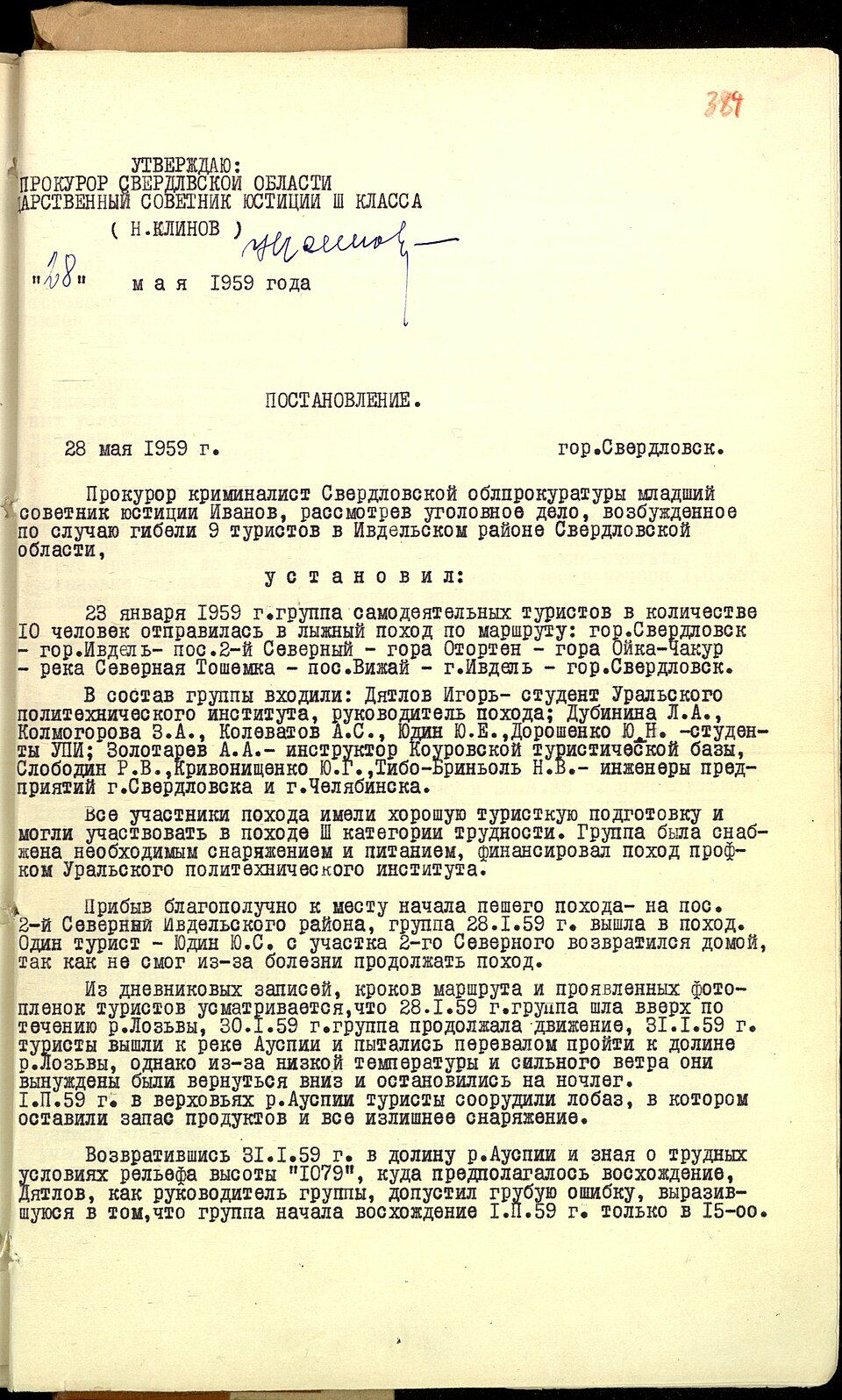
In May 1959, the inquest ended with no one to blame. The official cause was The files went into a archive.1
The timeline
- 1959
- Jan 23Group leaves Sverdlovsk with its route book.
- Jan 27Trek begins from Vizhai.
- Jan 28Yuri Yudin turns back, ill. He is the only one who lives.
- Jan 31Spare food and gear cached at the edge of the highlands.
- Feb 1–2The night. The group leaves the tent.
- Feb 12Dyatlov's telegram is due. None arrives.
- Feb 20First search teams sent.
- Feb 26Searchers find the tent, cut open from inside.
- May 4The last four found in the ravine.
- MayInquest closed. Files sent to a secret archive.
- SINCE
- Apr 2013Yuri Yudin dies, aged 75.
- Feb 2019Russian authorities reopen the case.
- Jul 2020Prosecutors announce an avalanche as the cause.
- Jan 2021Swiss researchers publish a model showing how a small slab avalanche could fit.
 Host
"Avalanches don't leave radiation"
Look at what the 1959 investigators actually wrote down. Radiation on a victim's clothing. Crushed chests and a fractured skull. Then they closed the case without naming a cause and locked the files away. That's not how you treat an accident.
And when Russia finally reopened it in 2019, which explanations did they consider? An avalanche, a slab avalanche, or a hurricane.1 Three kinds of weather. Not one question about what the military was testing in the Urals that winter. Hikers saw orange lights in the sky that very night, and nobody wrote it into the record.
 Host
"The mountain did it"
They cut a ledge into a snowy slope to pitch their tent. In 2021, two Swiss scientists showed how that could set up a small slab avalanche hours later, on a slope gentle enough that it would leave few traces. Their models produced the same kind of chest and skull injuries.3
Wake up to snow crushing the tent at −30°C and you cut your way out and get downhill fast. Six of nine died of cold, not wounds. The tracks show a walking pace, not panic from an attacker. Prosecutors reached the same conclusion in 2020.2 A terrible night needs no secret weapon.
Rex and June are fictional characters written for this site and appear in every file. They are not real people.
Lights in the northern sky
On the night the hikers died, another group camped about 50 kilometers to the south reported orange spheres glowing in the northern sky. Similar lights were reported around Ivdel through February and March 1959.1
None of those sightings made it into the 1959 investigation. Believers see a cover-up. Skeptics say lights in the sky don't explain injuries on the ground. Both sides agree on one thing: someone saw something, and nobody official asked about it at the time.
What drove them out of the tent?
On film
Videos about this file from other creators, picked to show more than one side. Tap a tape to play it.
Videos are made by their channels, not by Rumor & Record, and reflect their creators' views. They load from YouTube only when you tap play.
The file
Common questions
What happened at Dyatlov Pass?
Nine hikers left their tent on a snowy mountainside at night, mostly without shoes or warm clothes, and all died. Six died of hypothermia. Two died of chest trauma and one of a skull injury.
Was the Dyatlov Pass mystery solved?
Russian prosecutors named an avalanche as the cause in 2020, and a 2021 Swiss study showed how a small slab avalanche could fit. Many people, including some relatives and researchers, are not convinced.
Why were the hikers barely dressed?
They left the tent in a hurry. Some of those found later wore clothes taken from friends who had already died. Hypothermia can also cause "paradoxical undressing," where people remove clothes as they freeze.
Who survived?
Yuri Yudin, who turned back on January 28 because of illness. He died in 2013.
Other open files
Sources
- Dyatlov Pass incident (Wikipedia; route, dates, findings, distances)
- Prosecutors say avalanche killed Dyatlov group in Urals in 1959 (TASS, Jul 2020)
- Researchers shed light on the 1959 Dyatlov Pass incident (Advanced Science News, on Gaume & Puzrin, 2021)
MKUltra
In 1953, ten government scientists sat down after dinner at a cabin on a Maryland lake. Someone had spiked the liqueur. Nine days later, one of them was dead.
Open file 100Photo credits: tent photo by Soviet investigators, 1959, and case file page by the Sverdlovsk Region prosecutor's office, both public domain; memorial photo by Dmitry Nikishin, public domain. All via Wikimedia Commons. Footprint map drawn for this file.