
The
Illuminati
On the night of May 1, 1776, a few men met in a forest near Ingolstadt, in Bavaria, to found a secret society. Their leader was a 28-year-old law professor who took the code name . Within ten years his order was outlawed. Within twenty, people were blaming it for the French Revolution.21
Blacked-out lines in this file can be declassified. Tap one.
Six things people say about the Illuminati. Some are on the historical record. Some are rumor. Sort them, then see what the record says.
A professor's secret club
Adam Weishaupt taught canon law at the University of Ingolstadt, a Catholic university where the Jesuits still held great influence. He was a man of the Enlightenment, and he wanted a network of like-minded people who could work for reason against what he saw as superstition and church control.12
His plan was for members to rise into influential positions and use them to build a more moral society, closer to what he imagined as humanity's original liberty and equality.1
He borrowed the structure of the Freemasons and the Jesuits: a ladder of grades, with an inner circle whose real aims were hidden even from lower-ranking members.1
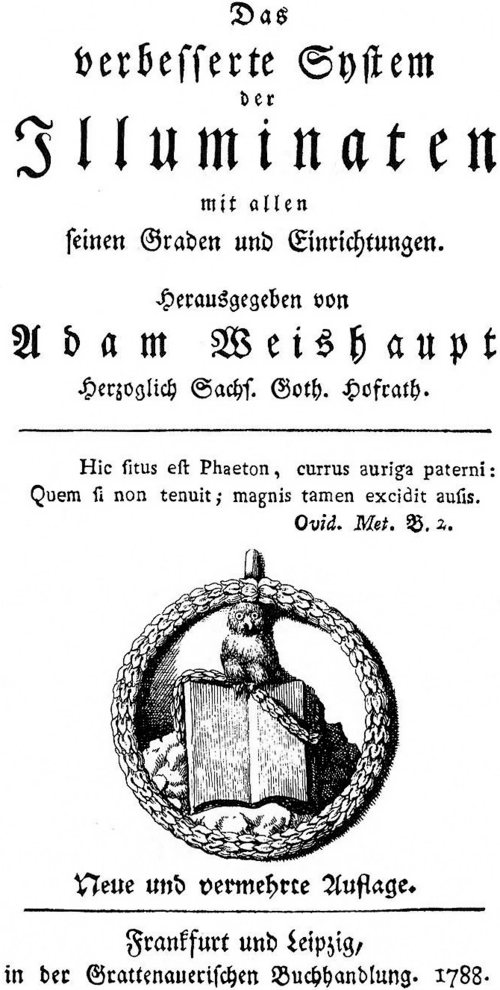
Recruitment took off after Baron Adolph von Knigge joined and spread the order beyond Bavaria. Members are said to have included noblemen and some of the best-known writers of the day.12
Outlawed
The secrecy didn't last. In June 1784, Bavaria's ruler, the Duke-Elector, banned all unauthorized societies. In March 1785 he banned the Illuminati by name. In 1787 a third edict made membership punishable by death.2
Police raided members' homes and seized the order's papers. The government then published them as evidence against the society.12
Weishaupt lost his post and left Bavaria. He spent the rest of his life in Gotha, in Saxony, teaching and writing.2
The ghost that wouldn't die
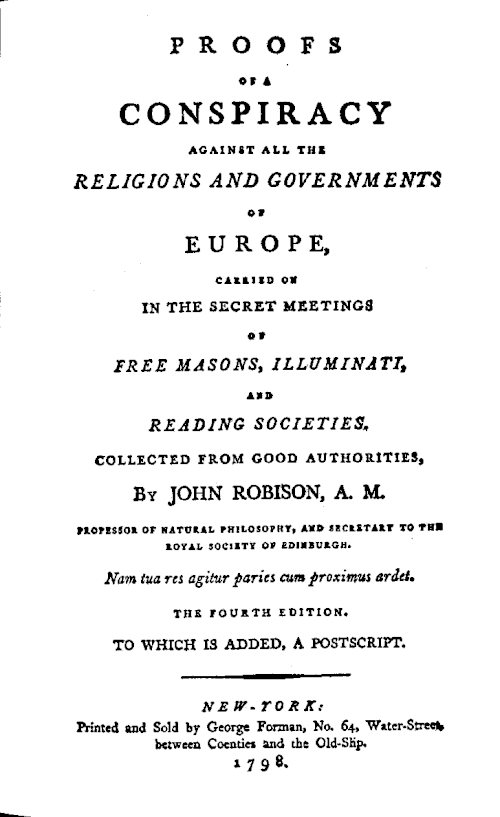
The order was gone. The idea wasn't. In 1797, two writers working separately, the French priest Augustin Barruel and the Scottish scientist John Robison, published books blaming the Illuminati for secretly planning the French Revolution. Both books were widely read and shaped conspiracy thinking for the next two centuries.1
Over the 20th century, some versions of the theory were folded into antisemitic conspiracy myths. This file covers the historical order and the claims made about it, not those myths.
The modern, pop-culture Illuminati came later. In 1975, two Playboy editors who had spent years answering readers' conspiracy letters published The Illuminatus! Trilogy, a satirical novel built on the premise that every conspiracy theory was true. A card game followed in the 1980s.4
The eye on the dollar
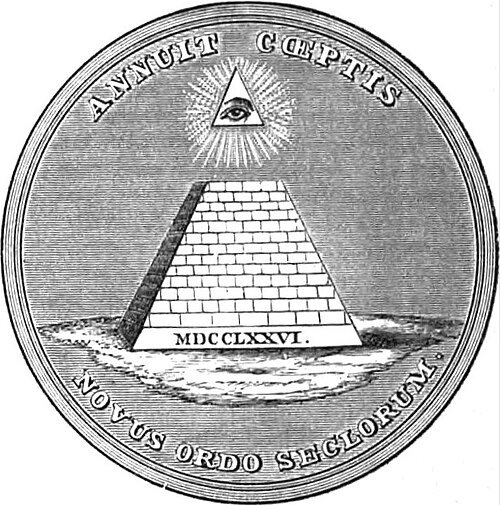
Turn over a U.S. dollar and you'll see an unfinished pyramid under a glowing eye. It's the most-cited "proof" of Illuminati influence.
The design comes from the reverse of the Great Seal of the United States, created in 1782. It went onto the dollar bill in 1935, when Vice President Henry Wallace and President Franklin Roosevelt chose to add both sides of the seal.3
 Host
"Banned doesn't mean gone"
Read what the founders actually built: a ladder of secret grades, with an inner circle whose real goals were hidden even from their own members, and a plan to get people into positions of influence.1 That's not a book club. That's a blueprint, and blueprints get reused.
When a government bans a secret society, the society doesn't hold a farewell party. It goes quieter. The two men who wrote about it in 1797 lived through those years and believed it survived.1 Maybe nobody calls it the Illuminati anymore. Private networks of powerful people who meet behind closed doors certainly still exist.
 Host
"It lasted nine years"
The Illuminati is one of the best-documented secret societies in history, and the documents tell a short story. Founded in 1776, banned by name in 1785, its papers seized and published, its founder teaching quietly in Gotha for the rest of his life.12
Everything after that is reputation. The 1797 books were written to explain a revolution their authors hated.1 The eye on the dollar predates the bill by 150 years.3 And much of today's Illuminati comes from a 1970s satire and a card game.4 When something gets blamed for everything, it's usually because it's convenient to blame.
Rex and June are characters written for this site and appear in every file. They are not real people. Their arguments come from the sources listed below.
The government made them famous
The Illuminati wanted to stay hidden. It was the Bavarian government that made them famous.
To discredit the order, the authorities published its seized papers, and the publication drew wide attention across Europe.1 The effort to expose a small society of a few thousand people may have done more to spread its legend than the society itself ever did.
Does the Illuminati still exist?
On film
Videos about this file from other creators, picked to show more than one side. Tap a tape to play it.
Videos are made by their channels, not by Rumor & Record, and reflect their creators' views. They load from YouTube only when you tap play.
The file
Common questions
Was the Illuminati real?
Yes. The Bavarian Illuminati was a secret society founded on May 1, 1776, by law professor Adam Weishaupt. It was banned in the 1780s.
What did the Illuminati want?
To place members in influential positions and promote Enlightenment ideals against superstition and the church's influence over public life.
Is the eye on the dollar bill an Illuminati symbol?
No record supports that. The pyramid and eye were designed for the Great Seal of the United States in 1782 and added to the dollar in 1935.
Does the Illuminati still exist?
There is no record of the original order operating after its suppression in the 1780s. Groups that use the name today were founded much later.
Other open files
Sources
- The Illuminati (International Institute of Social History)
- Adam Weishaupt and the Illuminati (National Geographic)
- Is the pyramid and eye on the Great Seal a Masonic symbol? (GreatSeal.com)
- The Illuminatus! Trilogy (Wikipedia)